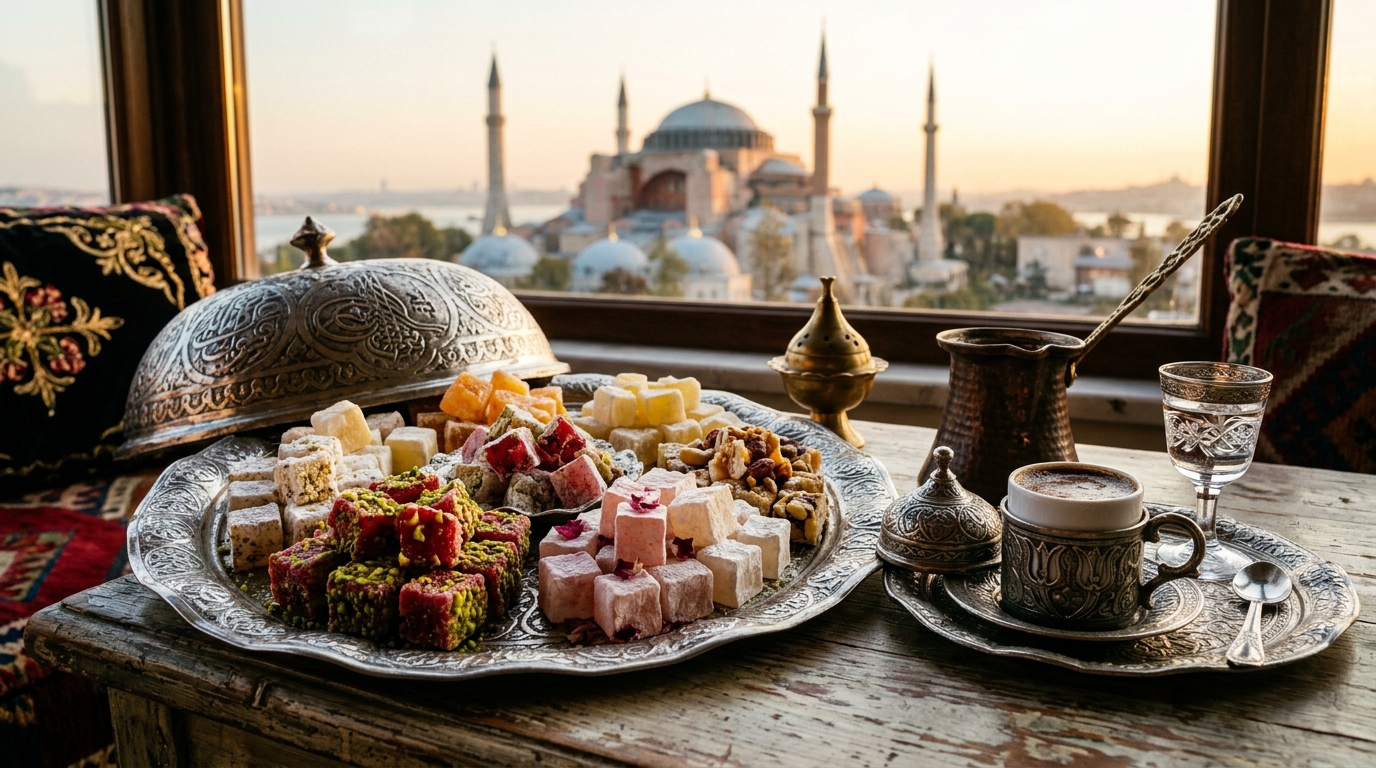
Whether offered on an engraved silver saucer beside a smoking demitasse of Turkish coffee or presented as an imperial token of goodwill, Turkish Delight is one of the grandest gastronomic gifts the East has bestowed upon the world. Yet, what exactly is this delicate jewel of a sweet, what does its ancient name signify, and how did it conquer both Ottoman palaces and European royalty?
Etymology: What Does 'Hulkum' Mean?
The word "Hulkum" (حلقوم) traces directly to Classical Arabic, translating anatomically to "the throat or gullet".
In the imperial courts of Ottoman Istanbul, palace physicians and confectioners named this new creation "Râhat-ül Hulkûm" (راحة الحلقوم), poetic shorthand for "that which soothes the throat" or "throat-comforting morsel".
Through centuries of Ottoman everyday parlance, the mouthful evolved from "rahat lokum" to "lâkuma", eventually settling into modern Turkish as "Lokum". In the 1830s, an adventurous British traveler tasted it in the Grand Bazaar and brought chests back to England, christening it simply as "Turkish Delight".
"Turkish delight was more than a recipe; it was a sensory rebellion against stone-hard rock candies, replacing tooth-shattering brittleness with the softness of silk."
The 1777 Palace Miracle: How Lokum Was Invented
Legend and imperial records recall that Ottoman Sultan Abdulhamid I grew weary of the brittle, tooth-breaking boiled sugar drops (akide) served in Topkapı Palace. He demanded his court confectioners formulate a tender, yielding dessert that melted effortlessly on the palate.
Confectioners arrived in Istanbul from the Black Sea town of Kastamonu in 1777. By combining newly refined cornstarch with crystal beet sugar syrup and simmering the concoction over low coals for hours, they achieved the translucent, gelatin-free jelly that we cherish today. The Sultan was enchanted, and lokum rapidly became the supreme confection of the Sublime Porte.
From Istanbul to the World: Global Adaptations
Thanks to the vast trade routes of the Ottoman Empire, this sweet traveled across continents:
- The Arab Gulf & Levant: Known as "Halaw Raha" or "Raha", traditionally sandwiched between crisp tea biscuits.
- Egypt: Cherished under the name "Malban", often forming the sweet center of Eid celebration pastries.
- Greece & The Balkans: Pronounced "Loukoumi", served alongside Greek boiled coffee.
4 Hallmarks of Genuine Artisanal Lokum
- Elastic Springback: Press a cube gently with your finger; it will bounce back like memory foam without collapsing.
- Non-Sticky Dissolution: Unlike gummy candy or corn syrup sweets, it never clings to your enamel, dissolving cleanly into velvet syrup.
- Subtle, Non-Burning Sweetness: Pure beet sugar delivers a rounded floral sweetness with zero harsh throat-burning acidity.
- 100% Plant-Derived & Vegan: Pure cornstarch thermal gelling—never animal bone gelatin.
The Narnia Phenomenon: Pop Culture Magic
In 1950, C.S. Lewis published The Lion, the Witch and the Wardrobe, in which the White Witch tempts Edmund Pevensie with enchanted Turkish Delight. Edmund was so mesmerized by its rose-scented sweetness that he betrayed his siblings just for another taste.
For generations of international readers, Turkish Delight became an emblem of magical, irresistible decadence—an allure that holds true in every hand-cut cube from Ayasofya Lokum.
Frequently Asked Questions (FAQ)
What is the difference between Turkish Delight and Jell-O / gummy bears?
Gummy bears and Jell-O rely entirely on animal gelatin (derived from pig or cow hide/bones). Turkish Delight is 100% vegan, obtaining its chewy structure through the physical heat-gelatinization of plant starch and pure sugar.
How long does Turkish Delight last and how should it be stored?
Properly stored at room temperature (18°C–22°C) away from direct sunlight, artisanal delight maintains its optimal chewiness for 6 to 12 months. Never refrigerate it, as cold temperature crystalizes the sugar and hardens the starch.
Taste Living History with Ayasofya Lokum
Experience authentic Topkapı Palace recipes prepared daily with 100% crystal beet sugar and first-harvest Antep pistachios.
Explore The Royal Collection