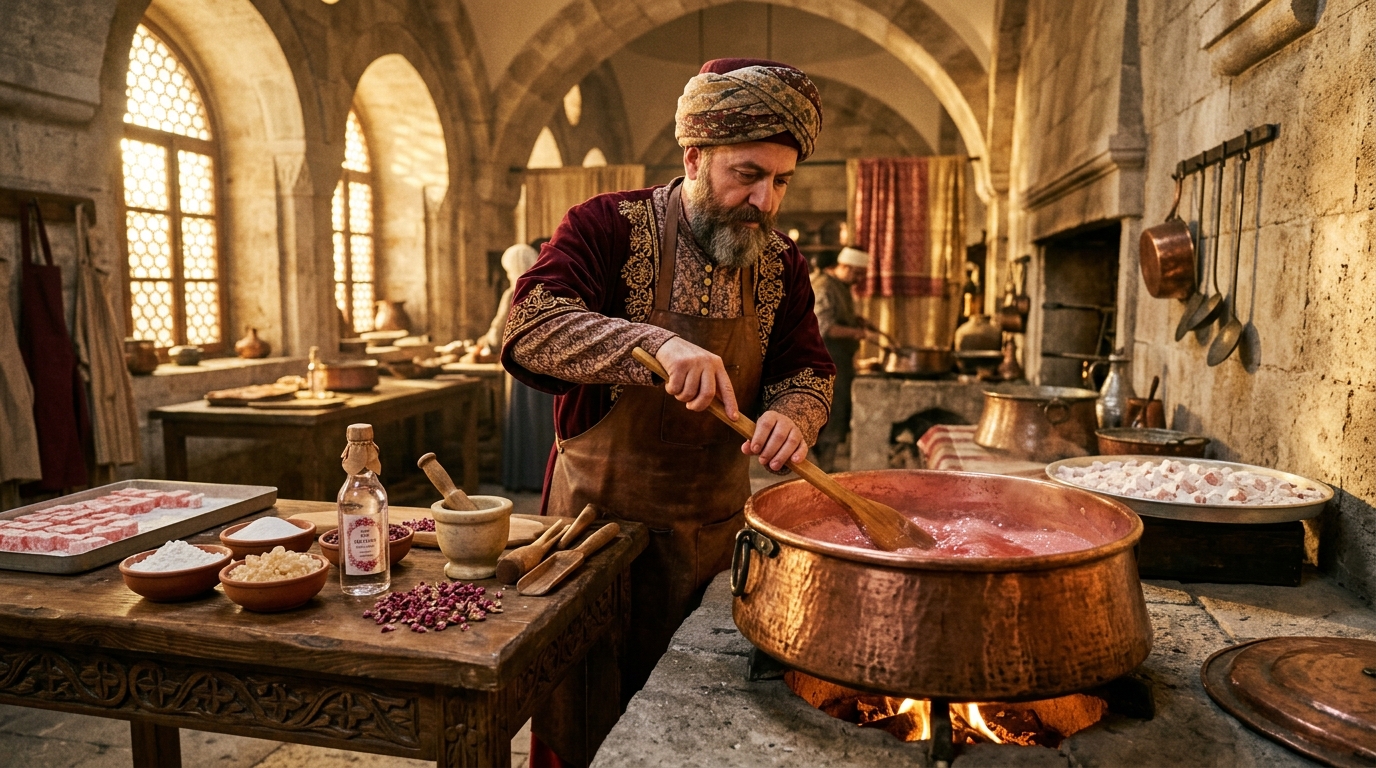
1. Before Lokum: Ottoman Confectionery Culture
Long before Turkish delight achieved international renown, the Ottoman Empire fostered a rich and sophisticated culinary heritage. The imperial kitchens of Topkapı Palace, known as the Matbah-ı Âmire, functioned as grand culinary laboratories. The craft of confectionery drew upon centuries of Near Eastern culinary wisdom, tracing lines back to ancient confections such as the Sassanid abhisa.
Prior to the late 18th century, sweets throughout Istanbul relied primarily on honey and grape molasses (pekmez) as natural sweeteners, bound together with flour. While flavorful, these early creations were heavy and lacked the refined, melt-in-the-mouth texture that defines modern lokum. Hard rock candies (akide) dominated the market, but their rigid texture often troubled the teeth of imperial courtiers, initiating a royal quest for a softer, more delicate confection.
2. The Revolutionary Moment: Starch Meets Sugar (1777)
The culinary breakthrough that gave birth to Turkish delight occurred around 1777. Two transformative ingredients entered the Ottoman capital simultaneously: refined beet sugar and purified cornstarch.
When palace masters replaced dark molasses with crystal-clear sugar syrup and substituted coarse flour with purified starch, a culinary miracle occurred. Slow simmering in thick copper cauldrons allowed the starch to gelatinize smoothly, yielding a translucent, bouncy jelly that melted on the tongue without chewing. In appreciation of its gentle sensation, it was dubbed "Rahatü'l-Hulkum"—Arabic for "comfort of the throat."
The 3 Golden Ingredients That Made History
- Refined Sugar: Replaced molasses and honey to achieve clear transparency and a pure, balanced sweetness.
- Purified Starch: Imparted the iconic elastic, chewable, and non-sticky gelatinous texture without gelatin.
- Rosewater & Lemon Juice: Infused delicate aromas while preventing sugar crystallization during the prolonged simmering.
3. The Palace Head Confectioners: The True Inventors
While popular folklore often credits a single personality with inventing lokum, historical records show that the creation was born of the collective mastery of the Şekerci Başı—the imperial chief confectioners. Operating in the palace's specialized confectioneries (Helvahane), these artisans continuously refined recipes for royal banquets and foreign dignitaries.
Sultan Abdul Hamid I (who reigned from 1774 to 1789) took an active personal interest in cultivating confectionery innovation, staging competitions among palace cooks. The resulting delicate starch cubes were so prized that the initial recipe remained an imperial secret, enjoyed solely by sultans, pashas, and palace ladies.
4. Hacı Bekir and the Democratization of Lokum
The transition of lokum from a palace secret to a public sensation is forever linked to Bekir Efendi (Hacı Bekir). Migrating from Kastamonu to Istanbul in 1777, he established his modest confectioner's shop in Bahçekapı.
Possessing exceptional artisan technique, Hacı Bekir took the palace's starch-sugar formulation and perfected it on a commercial scale. He began infusing the cubes with premium Mediterranean pistachios, hazelnuts, and Isparta rosewater. His mastery drew such widespread admiration that Sultan Mahmud II eventually appointed him Chief Confectioner to the Imperial Court.
"Hacı Bekir's shop became far more than a confectionery; it was a cultural salon where diplomats, poets, and travelers gathered to savor the sweet spirit of Istanbul."
5. How Lokum Conquered Europe as 'Turkish Delight'
During the 19th century, Istanbul flourished as an international nexus of trade and diplomacy. A British traveler visiting the Grand Bazaar encountered Hacı Bekir's lokum and purchased several wooden crates to take home to England.
Unable to pronounce the Arabic phrase rahatü'l-hulkum, the traveler introduced it to London high society under the moniker "Turkish Delight." It immediately captivated Victorian Britain, famously becoming a favorite of Queen Victoria. Exhibited at world fairs across London, Paris, and Vienna, it established itself as the universal ambassador of Ottoman confectionery excellence.
6. Frequently Asked Questions (FAQ)
Who is the inventor of Turkish delight?
The Ottoman palace confectioners (şekerci başı) invented Turkish delight. Later in 1777, Ali Muhiddin Hacı Bekir standardized the recipe and made it popular worldwide.
When was Turkish delight first made?
The roots of Turkish delight date back centuries in the form of 'abisa' (a sweet from the Sassanid Empire). However, its modern iteration—using starch and refined sugar—was developed in the late 18th century, specifically around 1777.
What inspired the creation of Turkish delight?
The creation of Turkish delight was inspired by the desire for a softer, more delicate alternative to hard candies. The sultan's demand for soft confections led the palace's head confectioners to experiment with starch and sugar, resulting in the famous 'rahat-ul hulkum'.
When did Turkish delight arrive in Europe?
Turkish delight arrived in Europe in the 19th century, brought back by British travelers who discovered the sweet in Istanbul. They introduced it as 'Turkish Delight', quickly making it a favorite delicacy, even enjoyed by Queen Victoria.
Taste the Centuries-Old Tradition
At Ayasofya Lokum, we honor the original 1777 palace recipes using traditional copper cauldrons and the finest natural ingredients. Discover our handcrafted gourmet collection.
Explore Our Collection