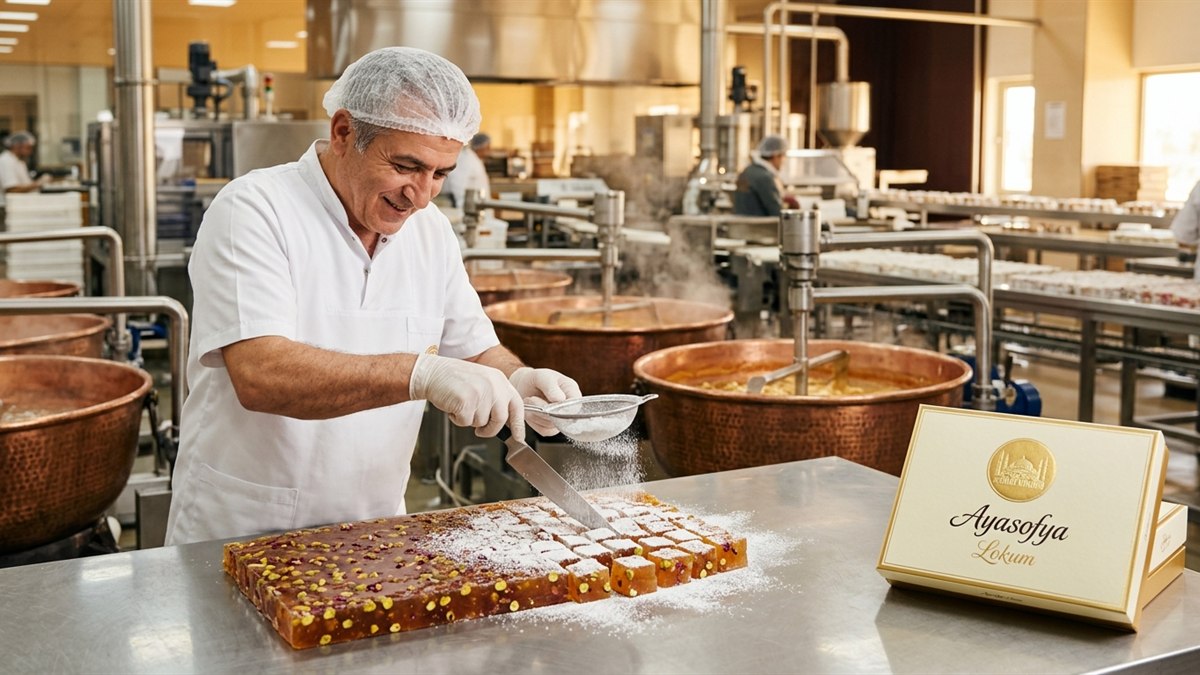
1. Raw Material Intake: Quality Starts at the Gate
The quality of Turkish delight is decided long before the cauldron is lit, at the moment raw materials arrive at the facility. The traditional recipe is remarkably simple, so the purity of every ingredient shows directly in the final product.
Before entering the production line, every batch is checked against these criteria:
- Crystal Beet Sugar: Only low-moisture, free-flowing, 100% beet-derived sugar is accepted. Glucose, fructose or corn syrup never enter the recipe at any stage.
- Starch: The only binding agent that forms the elastic body of the delight. Because no animal gelatin is used, lokum is naturally plant-based.
- Filtered Water: Used because it directly affects the clarity of the syrup and the amber translucency of the finished cube.
- Nuts and Flavorings: Pistachios, hazelnuts and almonds are tested for size, freshness and aroma; rose water and mastic are sourced from natural origins.
To learn exactly what each core ingredient does, read our Turkish delight ingredients guide.
2. Preparing the Syrup and Sugar Inversion
The first heated step is dissolving beet sugar completely in water to create a clear syrup. A small amount of citric acid is added at this stage.
With heat, citric acid splits part of the sucrose into glucose and fructose, a natural process called sugar inversion. Thanks to it:
- The delight does not crystallize and stays soft for months.
- There is no need to add ready-made glucose syrup.
- The sweetness is velvety and never burns the throat.
Mass producers skip this step to cut costs and pour in glucose syrup directly. We explain how that difference feels on the palate in our guide on how to identify real Turkish delight.
3. Adding Starch Slurry and Cooking 2.5-3 Hours in Copper Cauldrons
This is the heart of Turkish delight manufacturing. Starch is first dispersed in cold water, then slowly added to the hot syrup, and the mixture begins cooking in hammered copper cauldrons.
Copper spreads heat evenly across the vessel, so the starch gels without scorching or forming lumps. Mechanical paddles stir the mixture continuously for 2.5 to 3 hours. During this time:
- Water slowly evaporates and the mixture thickens.
- Starch granules fully swell into a transparent gel.
- The color shifts from milky white to clear amber.
The clock does not decide when cooking ends; the master does. By watching how the mixture flows off the ladle and how it stretches between the fingers, the master knows when to lower the heat. Delight rushed through pressurized steam vessels in 35-45 minutes never fully gels and turns out dull, sticky and lifeless.
4. Adding Flavors, Natural Colors and Nuts
Once the mixture reaches the right consistency, flavors and fillings are added in the final minutes of cooking. Aromas are left until the end so that delicate natural scents are not lost to prolonged heat.
- Rose Delight: Scented with natural rose water.
- Mastic Delight: Ground mastic gum is melted into the mixture.
- Pistachio, Hazelnut, Almond: Double-roasted nuts are folded in just before the cauldron is lowered, so they stay crunchy instead of absorbing moisture.
- Plain (Sultan) Delight: Left without flavoring to showcase the pure taste of sugar and starch.
Artisan production keeps nut content high and the kernels whole. Using broken or powdered nuts is the most typical cost-cutting shortcut in industrial delight.
5. Pouring into Trays and Resting for 24-48 Hours
The cooked mixture is poured into wide trays lightly dusted with starch and its surface is leveled. Then the most patient stage begins: resting.
The delight is left undisturbed for 24 to 48 hours in rooms with controlled humidity and temperature. During this time the starch gel sets, the slab firms up enough to be cut and the texture becomes uniform. This waiting period cannot be shortened; delight cut too early sticks to the knife, loses its shape and quickly starts to sweat.
6. Cutting and Dusting: The Powdered Sugar and Starch Blend
The rested slabs are lifted from the trays and cut first into long strips, then into even cubes. Immediately after cutting, every cube is coated with a fine blend of powdered sugar and starch.
This white coating is functional, not decorative: it stops the cubes from sticking to each other and to the packaging, and balances surface moisture to extend freshness. Full details on the blend and why it is used are in our section on the white powder on Turkish delight.
7. Hygienic Packaging and Shipping
Dusted cubes are packed in a hygienic environment that seals them off from air and humidity. From retail gift boxes to wholesale cartons, every package is closed to preserve the softness of the delight for months.
Packed products are stored in cool, dry warehouses at 18-22°C, and domestic and export shipments are planned under the same conditions. To keep your delight fresh at home, see our guide on how to store Turkish delight.
Comparison: Artisan Production vs. Industrial Mass Production
Although they share the same name, two production philosophies turn the delight on the shelf into completely different products:
| Production Stage | Artisan Method (Ayasofya Standard) | Industrial Mass Production |
|---|---|---|
| Sweetener | 100% crystal beet sugar | Glucose / corn syrup |
| Binder | Starch only, zero gelatin | Starch + modified additives |
| Cooking | 2.5-3 hours in copper cauldrons | 35-45 minutes in pressurized steam vessels |
| Consistency Check | The master's eye and hand | A fixed timer |
| Resting | 24-48 hours | Shortened or rapid cooling |
| Nuts | Whole, double-roasted kernels | Broken or powdered pieces |
| Result | Elastic, amber-clear, gentle on the throat | Dull, sticky, burns the throat |
Why Is Turkish Delight So Expensive? 4 Real Reasons Behind the Price
Seeing a large price gap between two boxes of Turkish delight that look almost identical is no coincidence. Four concrete cost factors determine the price of quality delight:
- Ingredients: Beet sugar costs more than glucose syrup and requires extra work for inversion.
- Time: 2.5-3 hours of cooking and 24-48 hours of resting mean far fewer batches per cauldron each day.
- Nut Content: Whole, fresh Antep pistachios are the most expensive component; the higher the share, the higher the price.
- Skilled Labor: Judging consistency, cutting and dusting are carried out by experienced masters.
In short, cheap delight is made by saving on one or more of these factors. We look at what defines premium quality more broadly in our guide what is luxury Turkish delight.
Can You Make Turkish Delight at Home? How It Differs from Factory Production
Making Turkish delight at home is possible, but keeping even heat and continuous stirring for hours on a household stove is difficult. Homemade delight therefore tends to be softer, less translucent and shorter-lived. Professional facilities use copper cauldrons, mechanical stirring, controlled resting rooms and hygienic packaging so that every batch comes out with the same quality.
If you are curious about the traditional palace recipe and its history, read our article on Ottoman Turkish delight.
Inside Our 1,000 m² Çatalca Facility: Retail and Wholesale Supply
At Ayasofya Lokum, we carry out all seven stages described above in our 1,000 m² modern indoor production facility in Çatalca, Istanbul. With a 5-ton daily artisan production capacity (10-ton infrastructure), our copper cauldrons use only 100% crystal beet sugar, natural starch and selected nuts, and we never compromise on our zero glucose and zero gelatin principle.
This capacity allows us to deliver fresh delight to gourmet consumers and to provide steady, consistent supply to hotels, cafés, retail chains and exporters. We detail bulk purchasing and distribution in our guide to wholesale Turkish delight direct from the manufacturer.
Taste what comes out of our copper cauldrons by exploring the Ayasofya Lokum flavor collection, or contact us for wholesale and export inquiries.
Frequently Asked Questions
How long does it take to make Turkish delight in a factory?
In artisan production, the mixture is cooked for 2.5-3 hours in copper cauldrons and then rested in trays for 24-48 hours. Including cutting, dusting and packing, a batch takes about 2-3 days to go from cauldron to box.
Does factory-made Turkish delight contain gelatin?
Traditionally made Turkish delight contains no gelatin. Its elastic texture comes from starch alone. Ayasofya Lokum never uses animal gelatin or glucose syrup at any stage of production.
Why is Turkish delight so expensive?
The price of quality Turkish delight comes from using beet sugar, long cooking and resting times, a high share of whole nuts and skilled labor. Cheap delight is usually made with glucose syrup, short cooking and broken nuts.
At which stage is the white powder added to Turkish delight?
The white powder is added right after the rested slabs are cut into cubes. This blend of powdered sugar and starch keeps the pieces from sticking together and preserves freshness.
Can I buy Turkish delight wholesale from Ayasofya Lokum?
Yes. With a 5-ton daily artisan capacity at our 1,000 m² facility in Çatalca, we supply hotels, cafés, retailers and exporters. Reach us through the contact section on our homepage.
Experience Royal Craftsmanship with Ayasofya Lokum
Indulge in artisanal confectionery crafted with 100% pure beet sugar, premium roasted nuts, and heritage Ottoman recipes. Produced in our 1,000 m² modern Istanbul facility with 0% glucose syrup and 0% animal gelatin.