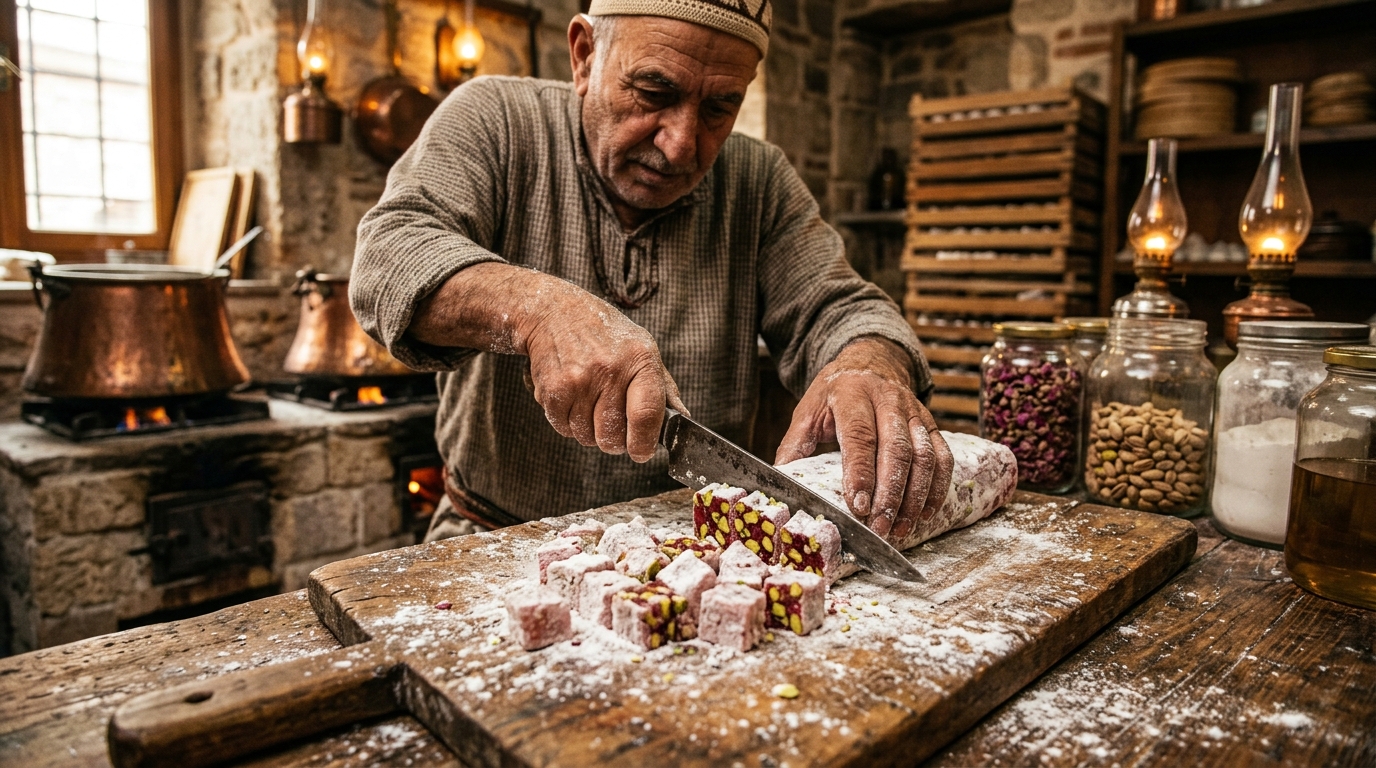
The word "Lokum" stems from the Arabic phrase "rahat al-hulkum" (راحة الحلقوم), which translates poetically as "comfort of the throat". In 15th-century Anatolia, dense confections cooked from honey, grape molasses, and flour were the early prototypes. Yet the translucent, bouncy, and velvety texture cherished across continents today was born in the 18th century through two revolutionary ingredients: refined cornstarch and pure beet sugar.
From "Rahat al-Hulkum" to World Confectionery
In 1777, confectioner Ali Muhiddin Hacı Bekir arrived from Kastamonu and established a modest workshop in Istanbul's Bahçekapı quarter. Winning the grand culinary competition held under Sultan Abdul Hamid I, he was awarded the revered title of Chief Confectioner to the Imperial Court, embedding Turkish delight into royal banquets and Ottoman diplomatic gifts.
"An English traveller in the late 18th century shipped cases of this confectionery from Istanbul to London under the label Turkish Delight, sealing its name forever in global gastronomic history."
In the Ottoman palace, presenting lokum on ornate silver filigree trays was not simply a sweet conclusion to a feast; it was a demonstration of courtly manners, imperial prestige, and diplomatic refinement.
No Gelatin: The Secret of Lemon Juice and Patience
Authentic Turkish delight never contains animal gelatin. Its extraordinary elasticity and chew are achieved purely through starch gelatinization and controlled acid inversion. For decades, Western pastry chefs attempted to replicate the recipe in Europe, frequently ending with either sticky syrup or rigid rock candy. What were they missing? The vital catalyst: fresh lemon juice (citric acid).
Without citric acid, sucrose molecules rapidly crystallize upon cooling. The gentle addition of fresh lemon juice inverts sucrose into glucose and fructose, preventing crystallization and keeping the confection wonderfully tender for months without any chemical preservatives. This chemical phenomenon was first documented scientifically in the 19th century by German researcher Friedrich Unger.
The Traditional 5-Stage Crafting Process
Mastering genuine Turkish delight demands hours of rigorous manual labor, precise temperature control, and relentless patience:
1. Syrup Boiling & Acid Inversion
Pure beet sugar, mineral water, and fresh lemon juice are brought to a precise boiling point of 115°C (soft-ball stage).
2. Cold Starch Suspension
Finely milled cornstarch is suspended in chilled water until perfectly smooth, then gradually folded into the boiling sugar syrup.
3. Slow Copper Cauldron Simmering
The mixture is simmered over gentle heat in solid copper cauldrons, continuously stirred with wooden oars for 2 to 4 hours until it reaches a glistening amber viscosity.
4. Natural Flavoring & Wooden Tray Resting
Genuine Isparta rosewater, Chios mastic, or Antep pistachios are blended in. The molten delight is poured onto starch-dusted wooden trays to rest and cure for 24 hours.
5. Dusting & Artisan Slicing
Cured slabs are lightly dusted with powdered sugar and cornstarch, then hand-sliced with double-handled confectioner blades into bite-sized cubes.
From Dickens to Narnia: A Global Cultural Icon
By the 19th century, Turkish delight had transcended the palace walls to become an iconic symbol in Western literature, cinema, and modern culture.
In 1870, Charles Dickens featured characters visiting Turkish delight shops in London in his final novel The Mystery of Edwin Drood. In 1950, C.S. Lewis immortalized the delicacy in The Chronicles of Narnia: The Lion, the Witch and the Wardrobe, choosing Turkish delight as the enchanted treat that tempts Edmund into betraying his siblings to the White Witch. Following the 2005 Hollywood film adaptation, sales of traditional Turkish delight skyrocketed by over 200% in the United Kingdom. Pop icon Madonna even titled a track after the confectionery on her 2008 album Hard Candy.
"The Queen let another drop fall from her bottle onto the snow, and instantly there appeared a round box, tied with green silk ribbon, which, when opened, turned out to contain several pounds of the best Turkish Delight." — C.S. Lewis, The Chronicles of Narnia
Preserving a 600-Year Heritage
Taking its name from the historic heart of Istanbul, Ayasofya Lokum keeps this timeless craft alive using 100% natural ingredients, PDO Antep pistachios, and pure Isparta rosewater.
Explore the Collection